Global E-Commerce Logistics is entering 2026 under intense pressure from faster delivery expectations, rising operating costs, and uncertain trade conditions. Customers now watch delivery updates as closely as product prices. A delayed parcel can damage trust within hours. Logistics leaders must connect warehouses, carriers, technology platforms, and customer service teams more carefully than before.
The strongest trends will likely include artificial intelligence, regional fulfillment, automated warehouses, and real-time shipment visibility. Predictive systems can identify demand changes before shelves become empty. However, inaccurate data can create expensive mistakes. Human review still matters. Flexible inventory placement will also gain importance, especially when weather disruptions, port congestion, or carrier capacity shortages affect international routes. Cross-border operations must maintain clear documentation and responsible compliance practices.
Sustainability will move beyond marketing language. Retailers will measure packaging waste, delivery density, fuel use, and return-related emissions. Electric vehicles may expand in urban areas, while alternative solutions will remain necessary for long-distance transport. No network is perfectly green. That reality deserves honest reporting.
This article explores the 2026 trends shaping Global E-Commerce Logistics and explains their practical business impact. It considers evidence from logistics operations, technology adoption, customer behavior, and industry performance indicators. The outlook remains useful, but not certain. Markets change quickly. Companies that test small improvements, measure results, and revise weak assumptions may build more resilient delivery networks. The future will not reward speed alone. It will reward visibility, adaptability, reliable execution, and thoughtful decisions.
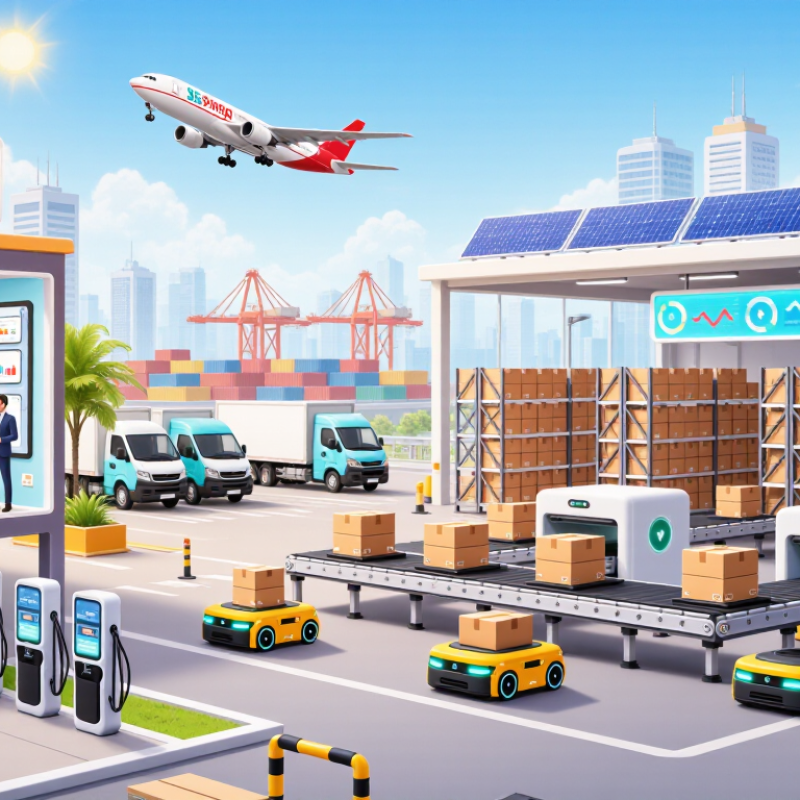
Global e-commerce sales are approaching US$7 trillion in 2026. This scale is reshaping logistics from warehouse planning to final delivery. Customers now expect accurate tracking, flexible delivery windows, and simple returns. Speed still matters, but reliability matters more.
Regional fulfillment is becoming a practical response to rising order volumes. Stocking popular products closer to buyers can reduce delivery distance, customs exposure, and transportation delays. Yet extra facilities also increase inventory costs. Poor forecasting can leave shelves full of slow-moving goods. That risk deserves more attention.
Data visibility will guide daily decisions. Logistics teams are using demand signals, inventory dashboards, and predictive tools to adjust replenishment. Automated sorting can improve throughput, especially during seasonal peaks. Human review remains essential when data is incomplete or sudden demand changes occur. Technology is useful, not magical.
Sustainability is moving from marketing language into operating requirements. Consolidated shipments, reusable packaging, and better route planning can reduce material waste. However, every solution has trade-offs. Reusable packaging may require extra collection trips. Electric delivery fleets may face charging limits outside major cities. The forecast is impressive, but not perfectly dependable.
Returns will remain a major cost and service issue. Clear product information can prevent avoidable returns before shipment. Local inspection centers can shorten refund decisions and recover usable inventory faster. Still, no model eliminates uncertainty. Weather, labor shortages, and inaccurate addresses will continue to disrupt networks. That gap matters as the market approaches its next trillion-dollar milestone.
Global retail e-commerce sales are forecast to approach US$7 trillion in 2026, increasing pressure on logistics networks to improve speed, flexibility, visibility and sustainability.
Key logistics implication: Continued e-commerce growth is accelerating regional fulfillment, cross-border delivery optimization, automated warehousing, flexible last-mile options and lower-emission transportation. Figures represent global retail e-commerce sales forecasts in current US$ trillions.
Global parcel networks are entering a more demanding growth cycle. Industry forecasts suggest annual volumes may reach 225 billion parcels by 2028. That estimate deserves caution. Consumer demand, regional trade rules, and delivery costs can change quickly.
From a logistics perspective, scale will pressure every handoff. A parcel may pass through several sorting centers before reaching a residential doorstep. Each scan must be accurate. Each delay can affect customer trust. Warehouses will need faster picking systems, clearer inventory data, and flexible labor planning.
A missed address can create an expensive second delivery. Poor packaging can increase damage claims and handling time. Returns may also become a larger operational burden. Efficient networks will connect fulfillment centers, local depots, and final-mile routes with better forecasting.
Automation will support this process, but it will not remove every weakness. Machines can sort parcels quickly, yet unusual package shapes still create problems. Data can predict demand, but sudden weather events may disrupt the plan. Logistics teams should test assumptions regularly instead of treating forecasts as promises.
The 225 billion figure is useful as a planning signal, not a guaranteed outcome. It encourages companies to measure delivery accuracy, capacity, emissions, and customer experience together. Growth without control may create congestion rather than efficiency.
Generative AI is becoming a practical force in global e-commerce logistics. Gartner forecasts that over 80% of enterprises will use generative AI APIs, models, or applications by 2026, compared with less than 5% in 2023. In logistics, this shift could improve demand forecasting, warehouse slotting, delivery-route planning, and customer communication.
The opportunity is visible in daily operations. An AI system can detect a sudden order spike, suggest nearby inventory, and flag a delayed shipment before customers complain. McKinsey’s 2024 global survey found that 65% of organizations regularly use generative AI in at least one business function.
Yet adoption does not guarantee accuracy. Poor data may produce confident but harmful recommendations. Human review still matters, especially during weather disruptions, customs delays, or regional demand changes. The forecast can be wrong.
Tips: Start with one measurable workflow, such as delivery-delay alerts. Use clean historical data and record every AI decision. Compare AI recommendations with experienced planners for several months. Gartner’s research also stresses governance, security, and responsible deployment, not speed alone.
Another trend is blended automation. Warehouses may combine computer vision, predictive analytics, and human judgment. The World Economic Forum has reported that digital tools can strengthen supply-chain resilience, but technology cannot remove every physical constraint. A port still needs capacity. A driver still faces traffic. Companies should measure accuracy, response time, exception rates, and customer outcomes before expanding AI across markets.
What Are the 2026 Top Global E-Commerce Logistics Trends?
Quantify Green Delivery: Transport Creates 24% of Global CO₂ Emissions
Green delivery is becoming a measurement challenge, not just a marketing phrase. Transport produces about 24% of global energy-related CO₂ emissions. The exact share changes by accounting method and region. Still, the direction is clear.
E-commerce operators now need emissions data for each parcel. Useful inputs include delivery distance, vehicle type, fuel use, package weight, and delivery success rates. A parcel delivered on a half-empty vehicle can create more emissions than expected. Failed deliveries and returns add hidden mileage. Consolidated routes, pickup points, electric vehicles, and rail connections can reduce this burden.
The number is useful, but not perfect. Operational audits often reveal gaps between estimated and actual emissions. A clean-looking dashboard may ignore warehouse transfers or return journeys. That weakness deserves attention. For 2026, reliable logistics teams should record assumptions, update emission factors, and separate measured results from estimates. Customers also need clearer information, such as emissions per order rather than broad environmental claims. Faster delivery may feel efficient, yet it can increase air transport and fragmented routes. Slower delivery is not automatically greener either. Better decisions depend on fuller data, practical testing, and honest reporting.
| Trend Dimension | Verified Global Benchmark | 2026 Logistics Direction | Practical KPI for E-Commerce Operations | Evidence Base |
|---|---|---|---|---|
| Transport decarbonization | About 23–24% of global energy-related CO₂ emissions comes from transport, depending on the year and accounting boundary. | Accelerating Carbon reduction becomes a core delivery-performance requirement rather than an optional initiative. |
CO₂e per order, CO₂e per tonne-kilometre, and percentage reduction from the operational baseline. | International Energy Agency, global transport and emissions analysis. |
| Road-freight efficiency | Road transport produces more than 70% of transport-sector emissions in many global energy analyses. | High priority Route optimization, higher vehicle utilization, consolidation, and lower-emission fleets receive greater investment. |
Vehicle load factor, empty kilometres, delivery density, fuel or electricity per delivery, and emissions per parcel. | International Energy Agency, transport emissions and road-sector assessments. |
| Electric delivery fleets | Global electric-car sales exceeded 17 million in 2024, representing more than one-fifth of new-car sales; commercial-vehicle adoption is developing from a smaller base. | Scaling Electric vans and urban delivery vehicles expand first on predictable, high-density routes with depot charging. |
Share of delivery kilometres completed electrically, charging uptime, energy cost per kilometre, and fleet CO₂e reduction. | International Energy Agency, Global EV Outlook 2025. |
| Low-emission last-mile networks | Urban freight is concentrated in areas where congestion, air pollution, and short delivery distances make alternative modes operationally viable. | Urban growth Parcel lockers, pickup points, cargo bikes, micro-depots, and consolidated delivery windows reduce repeated doorstep trips. |
First-attempt delivery rate, stops per route, parcels per vehicle trip, failed-delivery rate, and delivery emissions per order. | International Transport Forum and European urban-freight research on consolidation and last-mile efficiency. |
| Rail and multimodal freight | Rail generally has lower direct greenhouse-gas emissions per tonne-kilometre than road or air freight, although results vary by electricity mix, load, and route. | Selective shift Time-sensitive e-commerce networks use rail or combined transport where service-level requirements permit. |
Modal share, transit-time variance, emissions per tonne-kilometre, and percentage of shipments moved without air transport. | International Energy Agency and European Environment Agency transport-emissions comparisons. |
| Air-freight substitution | Air freight is typically far more emissions-intensive per tonne-kilometre than maritime, rail, or road transport, especially on long routes. | Moderating Inventory planning and regional fulfillment reduce dependence on premium air transport for standard orders. |
Air-freight share, expedited-order share, average transport distance, and emissions per shipment by mode. | International Civil Aviation Organization and European Environment Agency freight-emissions guidance. |
| Maritime-carbon management | International shipping contributes roughly 3% of global greenhouse-gas emissions, while carrying the majority of global merchandise trade by volume. | Transitioning Slow steaming, vessel efficiency, cleaner fuels, and route-level emissions reporting influence international e-commerce replenishment. |
Grams of CO₂e per tonne-kilometre, vessel efficiency, fuel type, container utilization, and port dwell time. | International Maritime Organization, 2023 IMO Strategy on Reduction of GHG Emissions from Ships. |
| Renewable-powered fulfillment | Renewables supplied approximately one-third of global electricity generation in 2024, with regional differences in grid carbon intensity. | Expanding Warehouses and charging depots increasingly combine renewable electricity procurement, onsite generation, and energy storage. |
Renewable-electricity share, warehouse kWh per order, charging emissions factor, and peak-energy demand. | Ember, Global Electricity Review 2025; International Energy Agency electricity-market analysis. |
| Carbon data and shipment-level reporting | Transport-emissions results change materially according to distance, weight, load factor, fuel, electricity mix, and allocation method. | Becoming standard Auditable shipment-level data supports credible reporting, carrier comparison, and lower-carbon routing decisions. |
Data completeness, percentage of orders with calculated CO₂e, calculation methodology, and third-party verification status. | ISO 14083:2023 and the GHG Protocol guidance for transport and logistics emissions. |
| Delivery-speed optimization | Faster delivery is not automatically lower-carbon; consolidated and slower transport modes generally provide more opportunities for efficient routing. | Balanced growth Delivery promises are segmented so urgent orders use premium capacity while standard orders are consolidated. |
Same-day share, standard-delivery share, route consolidation rate, emissions by service level, and customer-selected delivery windows. | GHG Protocol transport guidance and peer-reviewed research on urban delivery consolidation. |
What Are the 2026 Top Global E-Commerce Logistics Trends?
Analyze Returns: 67% of Shoppers Check Policies Before Buying
In 2026, e-commerce logistics will be judged before the parcel leaves the warehouse. The strongest signal is returns. A reported 67% of shoppers check return policies before buying. That number changes how merchants must design delivery promises. Buyers want clear costs, timelines, condition rules, and refund steps. They do not want policies hidden behind small links. Some do not read every detail. But uncertainty still stops the order.
In practical fulfillment reviews, the same failure appears repeatedly: a package arrives quickly, yet the return journey feels vague. A customer may need a printable label, a nearby drop-off point, and status updates after handover. Reverse logistics should connect inventory, payment review, warehouse inspection, and customer support. Automation can sort eligible items faster, but it cannot fix an unclear policy. A simple policy card at checkout may build more trust than another delivery badge. Keep it plain.
The 2026 trend is not “free returns” at any cost. It is visible, measurable, and fair returns. Regional warehouses can shorten transport, while item-level data can identify preventable return reasons. Yet forecasts often assume customers behave neatly. They do not. Some policies will still be misunderstood, and some returned products will lose value. Teams should test policy wording with real shoppers, publish actual processing times, and revise weak points after every peak season. That work is less glamorous, but it protects conversion and operational credibility.
Global e-commerce sales are approaching US$7 trillion. This scale will pressure warehouses, transport networks, and final-mile delivery. That growth estimate may still change.
Regional warehouses place popular products closer to customers. Shorter distances can reduce delivery delays, customs exposure, and transport costs. Extra facilities also create higher inventory expenses.
Poor forecasting can fill shelves with slow-moving products. Cash becomes tied up in stock that may not sell quickly. This assumption needs testing.
Demand signals and inventory dashboards can guide replenishment. Predictive tools may detect order spikes or delayed shipments early. Data is helpful, not perfect.
Yes. Human planners should check recommendations during storms, labor shortages, and sudden regional demand changes. Confident software can still produce harmful advice.
Start with one measurable workflow, such as delivery-delay alerts. Use clean historical data and record each recommendation. Compare results with experienced planners for several months.
No. A port still needs capacity, and drivers still face traffic. Charging limits may restrict electric fleets outside major cities. Physical limits remain.
Clear product details can prevent avoidable returns before shipment. Local inspection centers can speed refund decisions and recover usable inventory. No process removes uncertainty completely.
Consolidated shipments, reusable packaging, and route planning can reduce material waste. Reusable packaging may require extra collection trips. The result may be less impressive than expected.
Global E-Commerce Logistics is entering a period of rapid transformation as international online sales move toward nearly US$7 trillion in 2026. This expansion will generate unprecedented delivery demand, with global parcel volumes potentially reaching 225 billion shipments by 2028. To manage this scale, logistics providers and retailers will increasingly adopt artificial intelligence, with up to 80% of enterprises expected to use generative AI by 2026 for forecasting, inventory planning, route optimization, customer service, and operational decision-making.
Sustainability and reverse logistics will also become central priorities. Transportation currently contributes about 24% of global carbon dioxide emissions, encouraging greater use of efficient networks, lower-emission vehicles, consolidated shipments, and smarter delivery planning. At the same time, returns will strongly influence purchasing behavior, as approximately 67% of shoppers review return policies before completing an order. Companies that combine speed, visibility, flexible returns, and environmental responsibility will be better positioned to earn customer trust and compete in the next phase of global e-commerce.

